Sub-Zero Series · Classic Built-In · 2008–2022
Sub-Zero BI Series Repair in Mandarin, Jacksonville
The built-in that came with the kitchen remodel is now a teenager, and Jacksonville summers are hard on its electronics. We keep Sub-Zero® BI units running across Mandarin and the river streets behind San Jose Boulevard.
Sub-Zero built the Classic Built-In (BI) line from 2008 to 2022, and across Mandarin those units are now 10 to 18 years old. The repairs we see most are the post-storm brownout board lock, EC50 codes from dusty condensers, and hard-water ice maker valves. Most BI tickets land between $250 and $1,100, well under the cost of replacing a built-in.
For Sub-Zero repair in Mandarin and along the Scott Mill riverfront, call Mandarin Sub-Zero Repair at (904) 892-7163 or book online .
Service notes current as of June 13, 2026
First things first on a BI built-in
Who fixes a Sub-Zero BI series in Mandarin?
Mandarin Sub-Zero Repair is the family-run, independent shop that takes BI-series calls across Mandarin, Beauclerc, and San Jose — ZIPs 32223 and 32257 — at (904) 892-7163, or through our external online booking page when a kitchen-table call is not convenient. We are not Sub-Zero factory service and not affiliated with the manufacturer; we are the neighbors who keep out-of-warranty built-ins alive.
What does the first visit cost?
A diagnosis runs a flat, agreed fee that we roll into the repair if you approve the work the same day. You get a written quote before any part goes in — no open-ended hourly billing, even though specialist Sub-Zero labor in this market runs $150 to $250 an hour. The number you approve is the number you pay.
What if the panel went dark after a storm?
Bring it to us before you price a new refrigerator. A blank panel with the interior lights still on is the classic BI brownout lock — a board problem, not a dead unit. We try a controlled reset first; a board replacement is the fallback, and it runs a fraction of a built-in swap.
Which BI models turn up in Mandarin kitchens?
The line covers columns, over-unders, side-by-sides, and French-door layouts. The first thing we pin down on any call is the exact designation, because parts shifted across the variants.
| Model | Configuration | Built |
|---|---|---|
| BI-30U / BI-30UG | 30″ over-under, glass-door variant | 2008–2022 |
| BI-36U / BI-36UFD | 36″ over-under, French-door fresh food | 2008–2022 |
| BI-36R / BI-36F | 36″ all-refrigerator / all-freezer columns | 2008–2022 |
| BI-42S / BI-42SD | 42″ side-by-side, SD adds the door dispenser | 2008–2022 |
| BI-42UFD | 42″ under-counter freezer, French-door fresh food | 2008–2022 |
| BI-48S / BI-48SD | 48″ side-by-side, the largest of the line | 2008–2022 |
Suffixes finish the story: /O means overlay panels for a cabinet-matched front, /S is stainless, and the short-lived /F flush front from 2008 to 2009 is the one variant whose trim parts can take a hunt to source. Read your serial tag inside the fresh-food compartment and that single visit usually arrives with the right part already on the van.
Shop facts for BI owners
Set points that should hold
A healthy BI built-in holds 38°F in the refrigerator and 0°F in the freezer — Sub-Zero's own targets. After a repair or a power loss, give it a full 24 hours to stabilize before judging the temperatures.
What EC50 and EC40 actually flag
EC50 means excessive compressor run time on the refrigerator circuit; EC40 is the same complaint on the freezer side. They are run-time alarms, not death sentences — most clear after a condenser cleaning and a gasket check.
Where the condenser hides
On a built-in the condenser coil lives behind the upper grille, not under the cabinet. That single design fact is why so many BI owners never think to clean it, and why a choked coil is the quiet cause behind so many run-time codes.
What fails on a BI series at fifteen years?
The brownout board lock after a power outage
This is the headline BI failure in Northeast Florida, and it ties straight to where we live. The region records more than a hundred thunderstorm days a year and leads the country in cloud-to-ground lightning, so outages are routine — but the real damage comes the instant power returns, when the restoration surge can spike well above nominal voltage. That spike scrambles the BI control board. The tell is unmistakable: interior lights work, the panel stays blank, and the unit will not respond. A controlled reset wakes some boards; the rest get replaced. It is also the strongest argument we make for whole-home surge protection.
EC50 / EC40 run-time codes
Dirty condensers and tired gaskets drive these codes far more often than any sealed-system fault. We clean the coil behind the grille, confirm the door seals with a dollar-bill test, and watch a full cycle before we look any deeper.
Water inlet valve and ice maker faults
The ice maker's inlet valve solenoid is a known wear point at the 10-to-15-year mark, and Jacksonville's 14-to-28-grain water accelerates it — scale scars the seat until the valve weeps or refuses to open. We keep these valves stocked; the broader water story lives on our hard-water ice maker repair page.
Defrost heaters and condenser-fan triacs
A failed defrost heater lets frost blanket the evaporator until airflow chokes, and a burned condenser-fan triac on the board lets the compressor overheat. Both are diagnosable in one visit, and both are repairs rather than replacements.
What the build year tells us before we arrive
A 2008 BI and a 2021 BI carry the same nameplate but wear differently, and the serial date narrows the diagnosis before the van leaves. The line ran a full fourteen years, so "BI series" spans units that are barely out of warranty and units pushing twenty.
| Build window | Age in 2026 | Most likely call |
|---|---|---|
| 2008–2010 | 16–18 years | Gaskets, ice maker valves, defrost parts; flush-panel trim hard to source |
| 2011–2017 | 9–15 years | Brownout board lock, ice maker valve, EC50 from a dirty condenser |
| 2018–2022 | 4–8 years | Post-storm board lock and run-time codes; parts readily stocked |
The flush-panel /F trim from the 2008–2009 run is the one variant whose cosmetic parts can take a hunt, so reading the full designation off the serial tag — including the suffix — turns most visits into a single trip with the right part already on the van.
The brownout lock: repair, replace, or prevent?
Because the board lock is the headline BI failure in Mandarin, it is worth seeing the whole economics in one place rather than as a slogan. The restoration surge after a summer outage is the cause; here are the three ways the story can go.
| Path | What it costs | What it gets you |
|---|---|---|
| Controlled board reset | Diagnostic fee only | Wakes some boards outright — the cheapest outcome |
| Control board replacement | $550–$1,100 | A locked board swapped; the cabinet keeps its 20-plus-year life |
| Replace the whole built-in | Several thousand plus cabinetry | Rarely justified for a board fault alone |
| Whole-home surge protection | ~$900–$1,200 installed | Guards the board against the next restoration spike |
The lesson we repeat after every storm season: a dark panel with the lights still on is a board, not a funeral, and the surge device is the one upgrade that keeps it from happening twice. A built-in wired into an older Mandarin panel takes the full brunt of the spike, so the protection pays for itself the first time the grid hiccups.
A BI maintenance rhythm for Mandarin
Most BI calls trace back to two things this neighborhood does to a built-in: dust on the hidden condenser and scale at the ice maker valve. A light maintenance schedule heads off both before they become codes.
| Interval | Task | Why it matters on a BI here |
|---|---|---|
| Every 6 months | Vacuum and brush the condenser behind the upper grille | The coil hides up top, so owners forget it; oak debris clogs it fast |
| Every 6–12 months | Swap the cartridge water filter and air purification cartridge | Hard water exhausts the filter early and starves the ice maker |
| Yearly | Dollar-bill test every door and dispenser gasket | A leaking seal drives EC50/EC40 run-time codes |
| After any outage | Confirm the panel responds normally | A surge can lock the board even if cooling seems unaffected |
Symptom, first check, and cost lane
| What the BI is doing | First thing we check | Repair lane |
|---|---|---|
| Lights on, panel blank after a storm | Controlled board reset, then the control board itself | $550–$1,100 |
| EC50 or EC40 on the display | Condenser coil behind the grille, then door gaskets | $250–$550 |
| Ice maker quit, no fill sound | Water inlet valve solenoid and supply line | $550–$1,100 |
| Frost blanketing the freezer back wall | Defrost heater and defrost thermostat continuity | $550–$1,100 |
| Fridge warm, freezer fine, fan droning | Evaporator fan motor, then the condenser-fan triac | $250–$1,100 |
| Runs nonstop, partial frost on the coil | Refrigerant pressure — partial frost suggests a leak | $1,500–$3,000 |
Only that last row reaches sealed-system money, and it is the rarest of the set. The honest way to read this table: most BI calls in Mandarin close in the first two lanes, often the same afternoon.
Repair path, the proof we need, and the cost caveat
We do not quote the expensive repairs from a phone description, and we never quote a board or a sealed system before the evidence is in front of us. The rule on a BI is simple: an inexpensive cause has to be ruled out before a costly one gets named.
| Repair path | Proof we require | Cost caveat |
|---|---|---|
| Control board | Blank panel persists after a controlled reset | Some early-run boards are exchange-only |
| Sealed system | Partial frost plus a confirmed pressure reading | $1,500–$3,000; we show the math before you decide |
| Ice maker valve | No fill at the mold, scarred solenoid seat | Pair with a descale or the scale returns |
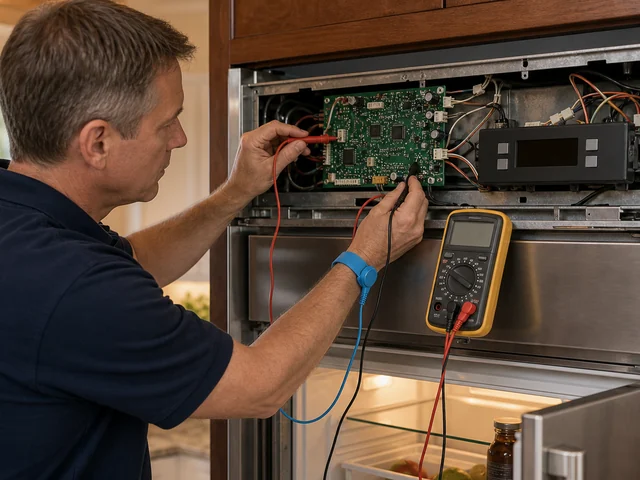
BI built-ins along the Mandarin river
The BI line landed right when a wave of Mandarin kitchens were being remodeled, so these units fill the bigger homes between San Jose Boulevard and the St. Johns, and they anchor the dock-side and riverfront kitchens out along Scott Mill and Beauclerc Road. Two local facts shape how they age. First, the lightning: a built-in wired into an older panel takes the full brunt of a restoration surge, which is why the brownout lock is our most common BI call after a storm season. Second, the water: the same 14-to-28-grain supply that scales kitchen ice makers also feeds the door-dispenser models, so a BI-42SD on a dock house works harder than the spec sheet ever assumed.
Several households along the river run a BI built-in plus a garage refrigerator and a wine unit, and we will check the fleet on a single trip. Gate codes, dock paths, and scheduling around the San Jose Boulevard bridge traffic are all covered in our Beauclerc and Scott Mill house-call notes.
From the route: a BI-36U that came back from the dead
An educational diagnostic scenario, told the way we would over the fence. A Beauclerc Road kitchen lost power in an August storm; when it came back, the family's BI-36U sat with its interior lights glowing and the temperature panel stone dead. They had already gotten a replacement quote with five-figure cabinetry work attached. On the visit the cabinet was cold, the compressor sound, and the board locked exactly as a brownout leaves it. A controlled reset did not take, so the control board was replaced — one part, one return trip for the ordered board, and the fourteen-year-old built-in went back to holding 38 degrees. The lesson we want every BI owner to keep: a blank panel after a storm is a board, not a funeral.
Older kitchen down the street with a warm shelf instead of a dark panel? The diagnosis shifts with the generation — compare the 600 series failure patterns to see how fifteen years of design changes move the answer.
BI series questions, answered plainly
My BI-36U has interior lights but the control panel is completely blank — is the refrigerator finished?
Almost never. That exact pattern — lights on, panel dead — is the BI brownout lock, where the surge from power coming back after an outage scrambles the control board. The cooling logic stalls but the cabinet and compressor are usually fine. We try a controlled board reset first; if that fails, the board is replaced. Replacing a board beats replacing a built-in by thousands of dollars.
How do I read the difference between a BI-42S, a BI-42SD, and a BI-42UFD?
The number is the width in inches and the letters describe the layout. The S is a side-by-side, the SD adds a through-door dispenser, and the UFD is an under-counter freezer with French doors up top. Suffixes like /O for overlay panels or /S for stainless tell us the door treatment. We confirm the full designation off the serial tag because parts changed across those variants.
Does an EC50 code on my Sub-Zero always mean an expensive repair?
Usually it is the opposite. EC50 flags excessive run time on the refrigerator circuit, and nine times out of ten the cause is a condenser packed with dust or a door gasket that no longer seals — both inexpensive fixes. We clear the coil, verify the seal, and watch a full cooling cycle before chasing anything deeper. Only if run time stays high after that do we look at sensors or the sealed system.
Where is the condenser on a built-in, and can I clean it myself between visits?
On a BI series the condenser sits behind the upper grille at the top of the unit, not underneath like a freestanding fridge. You can vacuum and brush the visible coil with the unit running — Sub-Zero asks for this every six to twelve months. Under the Mandarin oak canopy we lean toward six. What you cannot reach safely is the fan and the back of the coil, which is part of our maintenance pass.
Are BI series parts still available now that the line was discontinued in 2022?
Yes, broadly. The BI series ran from 2008 to 2022, so it is recent enough that water inlet valves, gaskets, fan motors, defrost components, and control boards are still stocked or available as factory exchanges. A handful of early flush-panel parts from the 2008 to 2009 run are getting harder to source, which is the one place we sometimes have to hunt — and we will tell you before ordering if your variant is one of them.
A 2009 BI-48S versus a 2020 one — do they fail differently as they age?
They do, and the build year is the tell. Early units from 2008 to 2010 are now into gasket, ice maker valve, and defrost-component territory, and the short-lived flush-panel trim from that run is the hardest to source. Later units, 2018 to 2022, are young enough that their most common visit is still the post-storm board lock plus EC50 codes from a dirty condenser. We read the serial to know which decade of wear we are walking into.
Will a surge protector strip on the outlet save my BI control board?
A point-of-use strip helps a little, but a built-in is usually hardwired or on a dedicated circuit where a plug-in strip never enters the picture. The protection that actually matches the Northeast Florida lightning risk is a whole-home surge device at the panel, roughly $900 to $1,200 installed, which clamps the restoration spike before it reaches the board. We recommend it to every BI owner who has been through one brownout lock.
How long should a BI built-in last before I plan to replace it?
Sub-Zero builds these for a 20-plus-year service life, and we routinely keep 2008-era units running well past their teens with board, gasket, and ice maker work. The cabinet and compressor outlast the electronics, so a board or valve repair buys years, not months. Planning to replace makes sense only when a sealed-system failure stacks on top of other aging parts — and even then we show you the repair math first.
Related Sub-Zero help
Service pages around the site
- Sub-Zero refrigerator repair in Mandarin
- Sub-Zero freezer repair
- Hard-water ice maker repair
- Wine cooler and wine storage repair
- 600 series repair help
- Loud, buzzing, or clicking unit
- Water leaking inside or underneath
- The well and hard-water owner guide
- Common questions, answered
- Book a repair visit
Let's get your Sub-Zero back to quiet shelves, cold milk, and clear ice.
Weekdays 8 a.m.–6 p.m. · Saturday 8 a.m.–noon