Refrigerator Service · Mandarin · Beauclerc · San Jose
Sub-Zero Refrigerator Repair in Mandarin
Warm shelves never pick a convenient week. We diagnose and repair Sub-Zero® built-ins across Mandarin's riverfront and inland streets, usually within days of your call.
If your Sub-Zero refrigerator in Mandarin is running warm, the cause is usually a failed thermistor, a tired evaporator fan, or a control board — not a dead unit. We diagnose in one visit, quote in writing, and most repairs land between $250 and $1,100, far below the price of tearing out cabinetry.
For Sub-Zero repair in Mandarin and along the Scott Mill riverfront, call Mandarin Sub-Zero Repair at (904) 892-7163 or book online .
Service notes current as of June 13, 2026
Signs your Sub-Zero refrigerator needs a visit
Mandarin Sub-Zero Repair handles refrigerator calls across Mandarin, Beauclerc, and San Jose — ZIPs 32223 and 32257 — at (904) 892-7163, or through our external online booking page when that suits the schedule better. These units rarely quit all at once; they drift, hum, and drop hints for weeks first. Worth a call if you notice any of the following:
- Shelf temperatures creeping above 40°F while the freezer holds steady near zero
- The compressor kicking on and off every few minutes — or running all afternoon without a break
- A sheet of ice under the crisper drawers, or water sneaking out past the kickplate — our page on where Sub-Zero leaks actually start walks through that one
- The service light glowing, or panel temperatures that disagree with a shelf thermometer
- New rattles, clicks, or a hum you can hear from the hallway — translated on our noise troubleshooting page
- Doors that need a shove to seal, or condensation beading along the frame
One symptom alone is worth a conversation. Two together usually means the unit is compensating for a failing part and burning extra electricity to do it.
What actually fails inside a Sub-Zero refrigerator?
After enough years under Mandarin roofs, the same handful of parts cause most of the trouble. Here is where we look first.
Thermistors and temperature sensors
A thermistor is a small resistor whose electrical value changes with temperature; it is how the control board knows what is happening inside the cabinet. When one drifts, the unit cools to the wrong number while the display insists all is well. Cheap part, big consequences, single-visit fix.
Evaporator fan motors
The fan that pushes chilled air through the compartments wears out quietly. The classic pattern on 1996–2009 units — freezer fine, refrigerator warming — is covered in detail in our 600 series repair guide.
Control boards
Boards fail two ways around here: old age on 600s, where a corrupted EEPROM shows double dashes on the display, and surge damage on newer units after summer outages. What we see on BI series units is usually that second kind.
Condensers and the sealed system
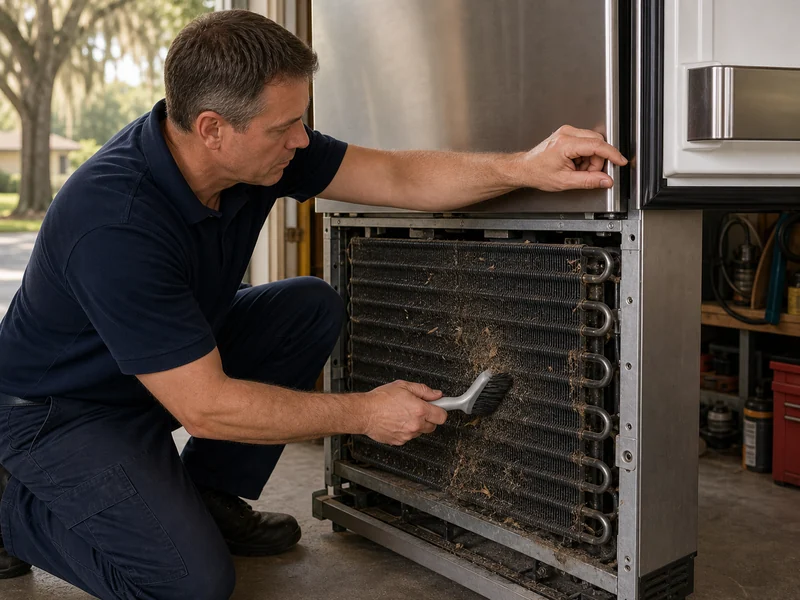
A condenser matted with dust and pet hair makes the compressor run hot and long — Sub-Zero itself calls for a coil cleaning every 6 to 12 months. True sealed-system work, meaning the evaporator or refrigerant circuit, is the expensive end of the trade at $1,500 to $3,000, and we will always tell you before a diagnosis heads that direction.
Why Mandarin kitchens work refrigerators harder
Most of the housing between San Jose Boulevard and the St. Johns went up between the 1970s and the late '90s, which puts a lot of original and second-generation Sub-Zeros deep into their service years. Parts wear out on schedule; the trick is knowing which revision your unit carries.
Then there is geography. Second refrigerators in garages under the oak canopy spend summer pulling against 90-degree, dripping-humid air, and gaskets along the river at Mandarin Point and Plummer's Cove age a few seasons faster than the spec sheet promises. Add July lightning — this corner of Florida leads the nation in strikes — and control boards have a harder life here than almost anywhere.
On the water with a dock and a gate code? Our riverfront house-call notes for Beauclerc and Scott Mill cover how we handle those visits.
What does Sub-Zero refrigerator repair cost here?
| Repair | Typical range |
|---|---|
| Condenser cleaning, evaporator fan motor, drain clearing | $250–$550 |
| Thermistors, door gaskets, mechanical controls | $550–$1,100 |
| Compressor replacement | $1,000–$2,000 |
| Sealed system — evaporator, refrigerant circuit | $1,500–$3,000 |
Specialized Sub-Zero labor in this market runs $150 to $250 an hour, which is exactly why we quote the whole job in writing after diagnosis instead of billing open-ended hours. The number you approve is the number you pay.
What a technician actually does on arrival
A refrigerator that runs warm has a dozen possible causes, and guessing wastes your money. Here is the order we work a Sub-Zero diagnosis, every visit, so the cheap causes get ruled out before any expensive part gets named.
- We ask what changed — a storm, a remodel, a new water filter, a recent move of the unit — because the timeline usually points at the fault.
- The grille comes off and the condenser coil gets inspected; under the oak canopy it is matted with dust and pet hair more often than not, and a choked coil alone can warm the box.
- Cabinet temperatures get read with a calibrated probe, not the front display, so we know whether the panel is even telling the truth.
- We watch a full cooling cycle: compressor start, evaporator fan, and the frost pattern on the coil — full blanket, partial patch, or clean each means something different.
- Thermistors get checked against their resistance spec, and the control board's relays and the condenser-fan triac get tested under load.
- You get a written quote before any part goes in, and the unit gets a 24-hour window afterward to settle back to 38°F before we call the job finished.
Parts we replace most on Mandarin refrigerators
Across a year of calls between San Jose Boulevard and the river, a short list of parts accounts for most of the work. Knowing which one your symptom points to helps you read a quote.
| Part | Why it fails here | Series we see it on |
|---|---|---|
| Evaporator fan motor | Bearings wear after years of run time; freezer stays cold while the fridge starves for airflow | 600 series, BI built-ins |
| Thermistor / temperature sensor | Resistance drifts with age, so the board cools to the wrong number | All electronic generations |
| Control board | EEPROM corruption on 600s; restoration-surge lock on BI units after summer outages | 600-1/600-2/600-3, BI |
| Door gasket | River humidity hardens the vinyl years early, breaking the seal and overworking the compressor | Any unit, garage units worst |
| Condenser-fan triac | Solder fatigue on the board lets the compressor overheat and short-cycle | BI built-ins |
A board that fits a 632 will not always drop into a 650, and BI variants changed parts across the 2008–2022 run, so we confirm the revision from your serial tag before ordering — the same discipline we describe on our BI built-in repair page.
When to call now, when it can wait, and when to think replace
Not every symptom is an emergency, and not every aging unit is worth a sealed-system bill. Here is how we sort it.
| Situation | What it usually means | What to do |
|---|---|---|
| Shelves above 45°F, food at risk | Active cooling failure | Cooler the perishables, call same week |
| Slight warmth, faint drone, panel still correct | Early fan or coil issue | Book a diagnosis before it worsens |
| Board dead after a storm, cabinet still cold | Brownout lock, repairable | Don't price a new unit — get the board read |
| Sealed-system leak stacked on other failing parts of a 20-plus-year unit | Repair math tightening | Weigh the written quote against replacement; we show the numbers |
For a 600 series the repair-versus-replace decision almost always favors repair, because a built-in swap drags custom cabinetry into the cost — the longer version lives in our notes on keeping a 1996–2009 classic running.
Questions owners ask during refrigerator visits
How long does a refrigerator repair visit usually take?
Diagnosis runs 45 minutes to an hour — we pull the grille, read the thermistors, watch a cooling cycle, and check the frost pattern on the evaporator. If the part is on the van, the repair happens the same visit. Board swaps and ordered parts mean a short second trip, and the unit needs about 24 hours afterward to settle back to temperature.
The fridge side is warm but the freezer still freezes — what does that mean?
On 600-series units that pattern usually points to the evaporator fan motor that moves cold air up into the refrigerator compartment. On newer dual-circuit models it is more often a sensor or a refrigerator-side sealed-system fault. Either way it is a diagnosable, repairable problem — not a reason to start shopping for a new built-in.
Do you carry parts on the van for the first visit?
We stock the high-turnover items: thermistors, evaporator fan motors, common door gaskets, water filters, and inlet valves for the series Mandarin actually owns — mostly 600s and BIs. Control boards and sealed-system parts get ordered per unit, because revisions matter; a board that fits a 632 may not fit a 650.
What temperature should a Sub-Zero refrigerator and freezer hold?
Set 38°F for the refrigerator and 0°F for the freezer — that is Sub-Zero's own recommendation. If you are set there and a shelf thermometer reads five degrees warmer, something is compensating and deserves a look. After any repair or power loss, give the unit a full day to stabilize before judging it.
The fridge is warm but the light still comes on — does that rule out a power problem?
Not entirely. The interior light and the cooling system can be on separate circuits inside the cabinet, so a glowing bulb proves the unit has power but not that the compressor and board are healthy. On a 600 series a dark display with working lights points at the board; on a BI built-in the same picture is usually the brownout lock. We read the board, the compressor relay, and the thermistors to tell which one you have.
How fast does food spoil once a Sub-Zero stops cooling?
A closed, well-sealed Sub-Zero holds safe refrigerator temperature for roughly four hours after it quits, and a full freezer stays frozen close to 48 hours if you keep the doors shut. Mandarin's summer kitchen heat shortens both numbers. If shelves have climbed past 40°F, move the perishables to a cooler and call — that is a same-week priority for us, not a someday repair.
Should I unplug my Sub-Zero before a summer storm rolls through?
If a bad cell is bearing down and you can spare the cabinet for an hour, pulling the plug is the cleanest protection against the restoration surge that locks boards. Pull it before the outage, not during, and leave it off until power has been steady for a few minutes. The longer-term answer is a whole-home surge device, around $900 to $1,200 installed, which guards the board without you watching the radar.
Let's get your Sub-Zero back to quiet shelves, cold milk, and clear ice.
Weekdays 8 a.m.–6 p.m. · Saturday 8 a.m.–noon