Ice Maker Service · Our Most-Booked Repair
Sub-Zero Ice Maker Repair for Mandarin's Hard Water
The water around here is wonderful for live oaks and terrible for ice makers. We repair, descale, and recalibrate Sub-Zero® ice systems from Beauclerc down to Julington Creek.
Most Sub-Zero ice maker failures in Mandarin start with the water, not the machine: JEA supplies 14 to 28 grains per gallon of hardness, and older wells off Scott Mill Road add iron and sediment on top. We descale the system, swap scarred inlet valves and exhausted filters, and most visits close between $550 and $1,100.
For Sub-Zero repair in Mandarin and along the Scott Mill riverfront, call Mandarin Sub-Zero Repair at (904) 892-7163 or book online .
Page notes reviewed June 13, 2026
Why ice makers keep us busier than anything else
Ice maker trouble in 32223 and 32257 lands on our bench every single week — Mandarin Sub-Zero Repair is the family shop that takes those calls at (904) 892-7163, or through our online booking page if that suits the schedule better. The reason is geology, not bad luck. Jacksonville drinks from the limestone Floridan aquifer, so the water arrives loaded with dissolved calcium, and every freeze cycle leaves a little of it behind. Give that process a few quiet years and the hardest-working appliance in the kitchen is running through a straw.
The longer version of the water story — softeners, filter schedules, what wells do differently — lives in our owner's guide to well and hard water. And if your complaint is taste or color rather than quantity, head straight to the page on ice that tastes or looks wrong; that is its own diagnosis.
Reading the symptoms at the ice bin
| Symptom at the bin | Likely cause on this water | Repair lane |
|---|---|---|
| No ice at all, no fill sound | Inlet valve solenoid stuck or failed, supply line blocked | $550–$1,100 |
| Hollow, shrunken, or fast-melting cubes | Scale-narrowed fill tube shorting the mold | $550–$1,100 |
| Production down to a tray or two a day | Exhausted filter, packed inlet screen, or warm compartment | $250–$550 |
| Cubes fused into one block | Bin sat unused, or meltwater refreezing from a defrost fault | $250–$550 |
| Water dripping below the unit between cycles | Scale holding the valve seat open so it weeps | $550–$1,100 |
That weeping-valve row explains a surprising share of mystery puddles. If yours has already reached the floor, our walkthrough of where Sub-Zero water leaks begin covers what to check while you wait for us.
What hard water does inside the machine
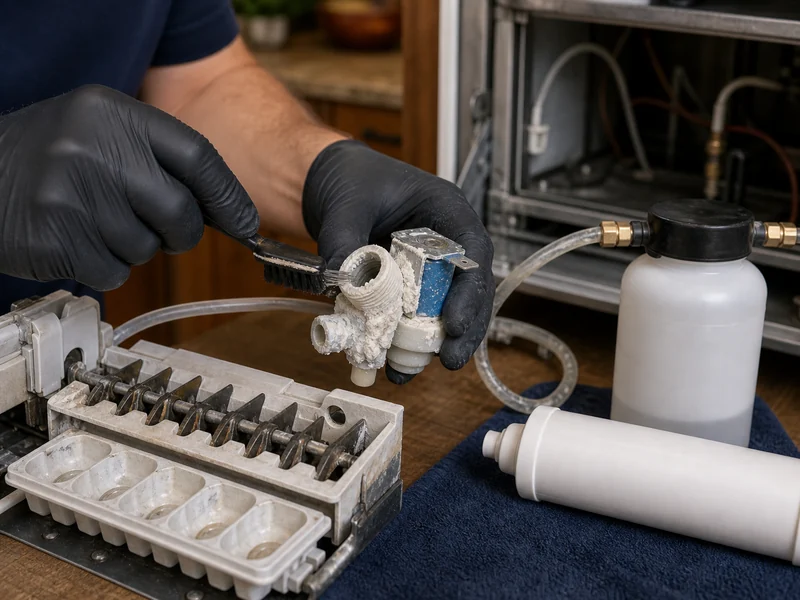
Scale settles wherever water slows down. The first casualty is usually the water inlet valve — a solenoid-driven gate that opens for a few seconds each cycle. Mineral crust on its seat does two bad things at once: it restricts the pour, and it stops the valve from closing fully, so it weeps between cycles. The second casualty is the fill tube, which narrows year by year until the mold gets a short pour and produces those hollow shells that water down a glass of tea in minutes.
None of that is a defect. It is simply what 14 to 28 grains per gallon does to any machine that freezes water for a living, which is why descaling on a schedule beats replacing parts in a panic.
How we rebuild a scaled ice maker
- Confirm the water source — JEA or private well — and check what is actually reaching the unit.
- Strip the assembly and descale the fill tube, mold, and supply line with a nickel-safe solution.
- Pull the inlet valve and inspect the solenoid seat; replace the valve if scale has scarred it.
- Fit a fresh filter cartridge, plus a sediment prefilter on well lines where there is room.
- Measure and calibrate the fill volume so the mold freezes full-size cubes.
- Run the first harvests to waste and verify cube size, clarity, and cycle time before we leave.
The whole sequence takes about two hours, and you get a written quote after the diagnosis — before any part goes in.
Which Sub-Zero ice systems turn up in these kitchens?
600 series ice makers, 1996–2009
The compartment-style makers in 632s, 650s, and 661s are sturdy, but their control logic flags a fault if the fill solenoid stays energized longer than 15 seconds — exactly what a half-blocked valve causes. Owners often read that as an electronics failure when it is really plumbing.
BI series, 2008–2022
BI-36U and BI-42 units pair the ice maker with a cartridge filter and an air purification system, and the inlet valve solenoid is a known wear point at the 10-to-15-year mark. We keep those valves stocked — more on the family's habits in our BI series service notes.
UC-15I undercounter ice machines, 2009 onward
The clear-ice machines in wet bars and summer kitchens concentrate minerals by design, so on this water they want a descale every year or two. Gravity-drain and pump-drain installs clog in different places; we check which one you have on the first visit.
How often should you descale on this water?
Descaling on a schedule is cheaper than replacing scaled parts in a panic, and the right interval depends entirely on what feeds your kitchen. Here is the rhythm we set for Mandarin homes based on their water source.
| Water source | Descale interval | Filter swap |
|---|---|---|
| JEA city water, no softener (14–28 gpg) | Every 18–24 months | Every 6–12 months |
| JEA water with a whole-house softener | Every 5+ years | Every 12 months |
| Private well, Scott Mill / Beauclerc | About yearly | Every 6 months, plus a sediment prefilter |
| UC-15I undercounter clear-ice machine | Every 1–2 years | Cleaning cycle per the harvest schedule |
Numbers shrinking before the interval is up are your cue to move the date forward — a hollow cube is the earliest honest warning the fill is starving. The full prevention plan, softeners and all, lives in our water and ice maker owner guide.
What the cube itself tells us
Before we open anything, the ice in the bin is a free diagnosis. A Sub-Zero cube should freeze clear, solid, and full-size; how it deviates points straight at the cause.
| What the cube looks like | What it points to | First check |
|---|---|---|
| Hollow or shrunken, melts fast | Starved fill from scale or a tired filter | Fill volume, then the inlet screen and filter |
| Cloudy or white-cored | High mineral load freezing into the cube | Hardness at the tap; descale schedule |
| Amber-tinted with an off smell | Iron and sulfur from a private well | Water source and the inlet filtration |
| Fused into one block | Bin sat unused, or meltwater refreezing | Usage pattern, then the defrost path |
Color and taste are their own diagnosis, separate from quantity — if that is your complaint, the page on ice that looks or tastes wrong goes deeper than this table can.
Slow ice, or a warm freezer? Telling them apart
"Hardly any ice" has two completely different roots, and pouring money at the wrong one is the most common mistake we get called in to undo. A starved fill and a warm compartment both cut production, but they leave different fingerprints.
A fill problem shows up as hollow, shrunken cubes from a machine that otherwise cycles on time — the mold simply gets less water than it should because scale has narrowed the tube or the inlet screen is packed. A warm compartment shows up as normal-shaped cubes arriving slowly, because the mold takes longer to freeze when the freezer has drifted off its 0°F set point. We measure both fill volume and compartment temperature on the same visit, so a defrost or fan issue does not get misdiagnosed as plumbing — and if the freezer side is the real culprit, we hand it to our freezer defrost and airflow service.
Wells, docks, and the Scott Mill stretch
The riverfront properties along Scott Mill Road and Beauclerc Road add a twist: a fair number were built in the 1970s and '80s with private wells, and several still use them. Well water brings dissolved iron and fine sediment that pack the inlet screen even faster than city scale does. We run that route weekly — there is a dedicated page for ice maker problems on Scott Mill and Beauclerc, and our riverfront service notes cover gate codes, dock-house units, and scheduling around the bridge traffic on San Jose Boulevard.
Ice maker questions we field on porches
How long does a full ice maker descale and rebuild take?
Plan on about two hours in the kitchen. We strip the assembly, dissolve the scale with a nickel-safe solution, inspect the inlet valve seat, fit the filter, and run the first harvests to waste before we pack up. If the mold assembly itself needs replacing, we order the part and the second visit is usually under an hour.
Is it smarter to replace the whole ice maker assembly than repair it?
Only when the mold is corroded past saving or the ejector mechanism has chewed itself up — and we will show you the part before recommending that. Most of the time the machine is healthy and the water side is the problem: a scarred valve, a packed screen, a spent filter. Rebuilding what is there typically costs half of what a new assembly runs.
Why did ice production slow to a tray or two a day?
Slow production is almost always a starved fill. Scale narrows the fill tube, the inlet screen packs with sediment, or an exhausted filter chokes the flow, so each cycle freezes a smaller pour. A warm freezer compartment does the same thing from the other direction — the mold takes longer to freeze, so fewer harvests happen per day. We measure fill volume and compartment temperature to tell the two apart.
Will a water softener stop the scale for good?
It helps enormously — softened water drops most of the calcium before it reaches the kitchen — but it does not retire the filter schedule, and it does nothing for iron or sulfur on a private well. Homes with softeners still see some buildup at the valve over the years. Think of a softener as stretching the descale interval from roughly two years to five or more, not eliminating it.
Do you work on the undercounter UC-15I ice machines?
Yes, and they need us more than anything else we touch. The UC-15I makes clear ice by constantly washing water over a freezing plate, which concentrates minerals fast — on water this hard the plates and pump pick up scale within a year or two. We descale them on a schedule for several households around Mandarin, and we check whether yours drains by gravity or pump, since the setups clog differently.
My ice maker quit completely but I still hear it try to cycle — what is stuck?
A unit that runs the harvest motion but produces no cubes is failing at the fill, not the freeze. The usual culprit on Jacksonville water is a water inlet valve whose solenoid seat has scaled over so it will not open, or a supply line and inlet screen packed with sediment from a private well. On a 600 series the board even flags a fault if the solenoid stays energized past 15 seconds. We measure what reaches the mold before condemning any part.
How often should a Sub-Zero ice maker be descaled on Mandarin water?
On straight JEA water at 14 to 28 grains per gallon, plan on a descale every 18 to 24 months — sooner if you notice cubes shrinking. A whole-house softener stretches that to five years or more. Private-well homes off Scott Mill see the fill screen pack faster from iron and sediment, so we lean toward yearly on those. The undercounter UC-15I wants its own descale every year or two because it concentrates minerals by design.
Can a clogged ice maker make the whole freezer warm up?
It works the other way around more often: a freezer drifting above 0°F slows or stops ice production because the mold cannot freeze in time. A scaled ice maker itself rarely warms the cabinet, but a weeping inlet valve can drip water that refreezes and blocks airflow or the defrost drain. We measure compartment temperature and fill volume together so a warm-freezer problem does not get misread as an ice maker fault.
Let's get your Sub-Zero back to quiet shelves, cold milk, and clear ice.
Weekdays 8 a.m.–6 p.m. · Saturday 8 a.m.–noon